Jess
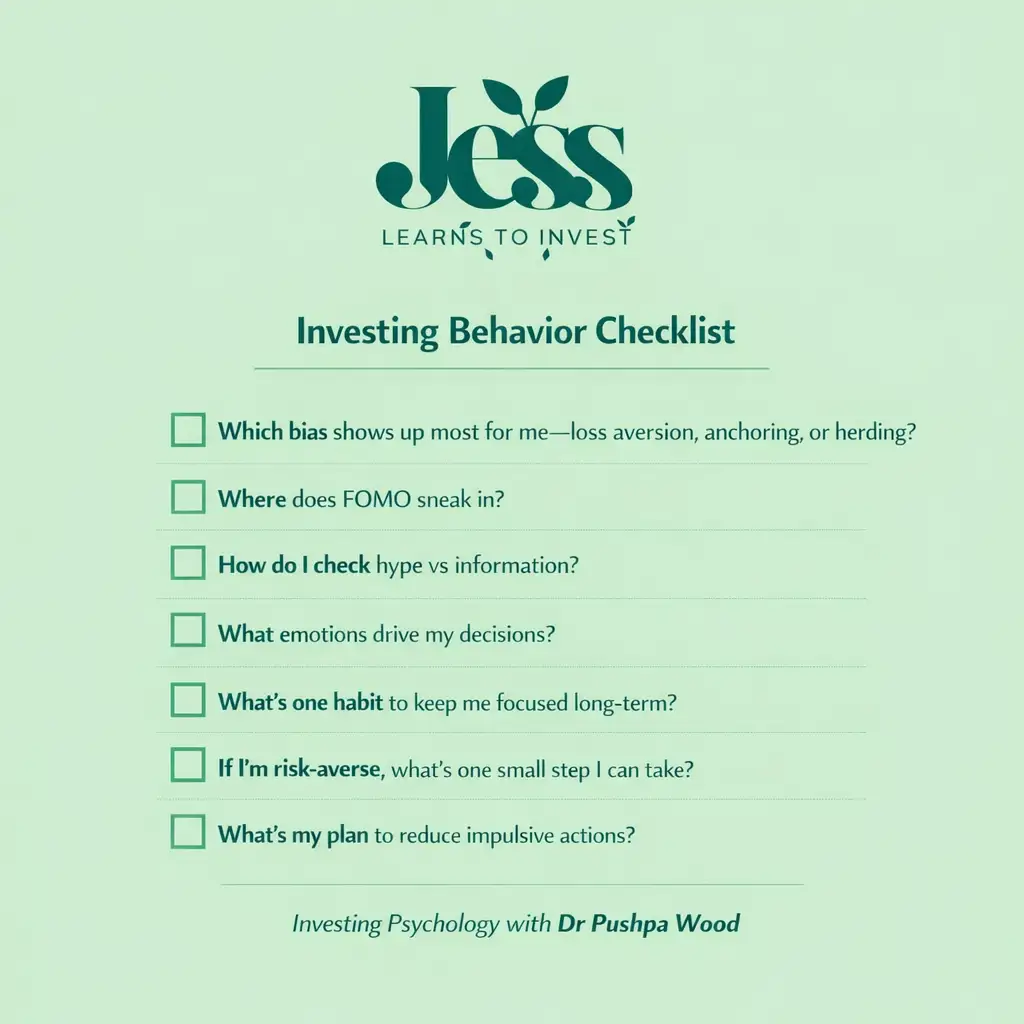
Kia ora, my name's Jess from the Communications and Delivery team here at the FMA, and you're joining me for Jess Learns to Invest Season 2. Season 1 was all about starting from the beginning. We started with an investing 101, and then we went on to talk about topics like shares, market volatility, bonds, and scams. Season 2 is all about levelling up so you can build your confidence and grow your knowledge. I'm very excited today. Our topic today is going to be psychology of investing. So we're going to be talking about things like FOMO, emotional investing, and tackling biases. I'm very excited to introduce our first guest, director at Massey University, Pushpa Wood. Welcome, Pushpa. Thank you so much for joining me today.
Pushpa
Thank you, Jess. I'm really looking forward to it.
Jess
Could you kick off by just introducing yourself to the audience and a little bit of your background in the financial industry?
Pushpa
Actually, Auntie Google can tell quite a lot about me. I look after financial education and research centre at Massey University. And I guess I've been in that role for over 13 years. So anything to know about money, I generally tend to make it my business. We do quite a lot of research as a centre. We do teaching. So we have a number of online courses, short courses. And also we create resources for community groups as well as businesses.
Jess
Oh, cool.
Pushpa
And our major project at the moment is, which we are really excited about, is developing the competency of the workforce that is engaged with working with people, anything to do with money.
Jess
So Pushpa, what is investment psychology?
Pushpa
I guess the best way to explain is we know the rules of investing, most of us who are in the game of investing. So we do know theory of investing, but do we actually follow that as a big question? So the investing psychology is knowing and then actually taking action on them, bringing the two things together. In other words, You invest it, that investment is for long term, but when you see the market start falling, that's where you start to get very itchy about it and you get on edge and you start, you forget about your long-term planning, you forget that it is supposed to be there for long term, and you try to take that out and miss out.
Jess
Emotions start to get involved.
Pushpa
So in other words, you need to learn when you are in the game of investing, A, it is a long-term, B, try and keep check on your impulses. I usually say sleep on it. Every time you try to feel, when you feel like taking your money out because everybody else is, that's when I say sleep on it and see what it looks like in the morning.
Jess
Yeah, very important. It's just like anything in life, like if you react straight away.
Pushpa
It is, very much so. We know things we shouldn't do, but we do. I mean, in Financial literacy, for example, classic thing is I've yet to come across a person who doesn't know that you cannot spend more than you earn. Everybody knows that. Yet, as a nation, our household debt is quite high.
Jess
And why is understanding investment psychology just as important as that financial literacy?
Pushpa
It is important because knowing the rules is one thing. and following those rules and then keeping check on your own biases, your own impulses, and being influenced by everybody else.
Speaker 3
Yeah.
Pushpa
It's important. So it's important to know what your comfort zone is. It's important to know how others can influence and therefore how can you protect yourself.
Jess
Yeah. And what are some common behaviours that you see in New Zealanders when it comes to their investing style?
Pushpa
I guess one is the herd behaviour is quite, everybody else is doing it. You don't want to miss out. So FOMO and herd behaviour, I call it, kind of close to each other. The other one is we get quite easily nowadays influenced by social media. Everybody else is talking about it. So therefore, It has to be good. And my usual rule of thumb is if it sounds too good to be true, it is too good to be true. And the other thing very important to remember is money is investing is not just simply numbers. It can be your whole security in your retirement. It can be security of your family. It can be security of the next generation that you are actually putting at stake. So it's quite a lot at stake simply by making a wrong decision.
Speaker 3
Yeah.
Pushpa
And it's important to know where your threshold or your tolerance level is. I mean, I'm a classic example of I'm a risk-averse person.
Speaker 3
Yeah.
Pushpa
All right. I really do. And sometimes in past it has happened is while I'm still calculating the risk-benefit analysis, the opportunity has gone, right? But I'm comfortable with that. Yeah. I'm not upset that I missed out on opportunity, but that's my style.
Speaker 3
Yeah.
Pushpa
And I know that. I know the risks and I know the benefits of it. So it's for each individual to know what your risk tolerance level is very important.
Jess
Yeah. And how would someone work that out if they're new to investing?
Pushpa
There are a lot of tools around. I mean, sorted is very good to actually go. FMA's got a lot of material there. are, I usually advise to people that if you are new to investment, do your homework. Yeah. All right. And if you don't have... shall we say, aptitude for doing your own research or understanding, then seek professional advice. That's what professionals are for. Again, I generally say to people, if you've got $20,000 to invest, then I'm sure you can afford $200, $300 for advice. So if you are going into that game of investing long-term and if you don't have knowledge or you don't have time and energy to do your own homework, then... Please do use the professionals. That's what they are there for. They will guide you. But there are a lot of tools available nowadays.
Speaker 3
Yeah, that's correct. Yeah.
Pushpa
The better armed is the best strategy.
Jess
Yeah. And what are some common investing biases that you notice? Because I know I've heard of loss aversion. I have no idea what that means. So what does that mean?
Pushpa
Loss aversion is people who feel more strongly about losing money than gaining money.
Speaker 3
Yeah.
Pushpa
Right? I feel like that's right. They want to avoid.
Jess
I hate checking my bank account, like that's gone, that's gone. Oh my God, anxiety.
Pushpa
The most... people I came across lost version was during COVID time.
Jess
Yeah.
Pushpa
I cannot tell you how many phone calls a week I was getting from people who knew me or friends. who knew me, that I deal, in their words, I deal with money. I've never touched money, but I deal with money as far as they were concerned. And so often, so because there was a lot going on in the market, they were very regularly, almost daily checking their Kiwi Saver account. And so when they see the bar going down, that's when there's, oh, I don't want to lose any more, therefore let me take this out. And then they miss out the opportunity.
Speaker 3
Yes, yeah.
Pushpa
The other one is everybody's doing it, so therefore I'm going to be actually looking at it. Social media plays quite an influential role in terms of your bias, building that. The other one is somebody, the term they use is anchoring, that you're kind of fixated in terms of where it should be.
Speaker 3
Right. Yeah.
Pushpa
And that's where you're continually looking at that. This is where the price should be. And you can see the trend is going downwards, but you're waiting for it to go back at a very high level. The professional advice is saying to you, this might be the time to get out.
Speaker 3
Yeah.
Pushpa
Right. But because you wanted to reach to that particular level, because you put $100, you want to make sure that you get at least 110.
Speaker 3
Yeah.
Pushpa
And you might end up missing out even 100.
Jess
Yeah, okay.
Pushpa
And that can be the, and then of course the herd behavior is, you know, Jess invested it. So Pushpa should also do that. Yeah. Not necessarily thinking about what is Jess's motivation behind investing as opposed to what is Pushpa's motivation behind investing it.
Speaker 3
Yeah, yeah.
Pushpa
What is your purpose for investing? Why do you want to invest?
Jess
Yeah, so it's kind of setting those goals before you start.
Pushpa
Setting the goals, having a very clear idea at the very beginning. What are you investing for? How are you planning to use that investment? And when are you planning to use that investment?
Speaker 3
Yeah.
Pushpa
Right? So the timeframe, the purpose, the amount, all of that plays quite an important role.
Jess
Yeah.
Pushpa
The bottom line is that you planned everything, you worked everything out, you have a plan, sticking to it is the key thing.
Jess
Yeah, that's the hard part, isn't it? That's the hardest part.
Pushpa
You see those ups and downs. Yeah, especially, yeah. So again, if you're investing long term, try not to be tempted checking weekly.
Speaker 3
Yep.
Pushpa
All right? Have some regular time frames. So check in terms of for regularity purpose, how often are you going to check? Are you going to be keeping an eye on the market? If worldwide market is being influenced, is that the right time for you to check and make decision? Yeah, so it's looking at what else is going around, because remember, your investment is being influenced by what's happening around the world, not what you're doing. Yes, you're simply putting money in and making decision which bucket the money is going in, but that... is being influenced by things that are not necessarily in your control.
Jess
Yeah, and that's when people panic as well, right?
Pushpa
Because it's out of in control. And that's when people go to the state of panic. It's gone down, it's gone down.
Jess
And how do these biases that you just talked about, how does that impact everyday sort of money decisions that we make?
Pushpa
That's interesting. And how is everyday money decisions One thing I am finding in my job is that invisibility of money is creating a lot more hassles than it's creating advantages, right? Yep, and that's something which is we still... doing some research that how much actually the invisibility of money has influenced people's decision-making and money. Because when it is in your hand, you can see and your spending habits can be very easily managed and controlled and been taken care of. When you don't see it and all you see is a plastic card and you're not in a habit of actually checking your spending, then that's where the challenges occur. And same goes for investment. Some are overly cautious that they're checking on a weekly basis. Things don't move that rapidly in investment, right? Because it's influenced by outside market, international markets. So it doesn't get, so if you are looking at it on a weekly basis, then I think you're creating a lot more stress for yourself than anybody else, basically. So it's important It's important to actually keep check, but keep check and periodical rather than on a very regular basis. Be, try not to be influenced by the hype. Yes. Because in a hype usually happens is all you hear about is how much money so-and-so has made. You never hear about how much they have lost.
Speaker 3
Yeah.
Pushpa
All right. So therefore, and that's where the difference between the hype and the information is hype will only tell you the advantageous side of it.
Speaker 3
Yes, right.
Pushpa
Whereas information will tell you. positives, the risks, the long-term risk, the short-term risk, all of that. And so try and stay into the information bucket rather than going into the hype. And social media is very, very good at creating hype. Finn influencers are very good at creating hypes. So it's important to know. I guess my rule of thumb is know your own tolerance level.
Speaker 3
Okay.
Pushpa
So if you are putting money on a high risk, just think about, is that the money you can afford to leave it for next five years.
Speaker 3
Yeah.
Pushpa
For next 10 years. So I generally say, if you're putting money in into a high risk, ask yourself a question. If tomorrow, I lose that money, can I afford to lose it without having a heart attack? Right? Yeah. If losing that is going to cause you a heart attack, then you need to think about your strategy, right?
Speaker 3
Yes, yeah.
Pushpa
And that's the important thing to look at it, is that what the money you're investing is, what purpose and what are you planning to use it for? And if you do lose it, what will be the consequences of it?
Jess
Yeah, because often you kind of hear, to have your rainy day fund, don't obviously spend all your money that you need for day-to-day living into your investments, but if you've got enough money to buy coffee on the regular, maybe that becomes your investment money.
Pushpa
Yeah, you can start to look at to say, okay, I do want to keep check on my spending and I want to spare some money each fortnight, right? Whether it's one coffee less a day and therefore it's worth 5 coffees and that money goes into my investment, whether you are actually putting additional amount into your kiwi saver, whether you got a account and shares or you're trying your hands out on something. then that's different. Your rainy day money is your rainy day money. It's not your investment money. And you need to differentiate that because investment money is something which is out of your reach instantly. You can't get to it instantly. Your rainy day money is you can get to it instantly if you need it. That's the purpose of it. Right? So separate between the two of them. Have a distinction between the two of them. If you are investing, then look at, it could be that you look at short-term investment, time-bound, right? Or you can look at mid-term investment, again, time-bound. I am putting this money aside for this particular purpose, right? Or you can do a long-term that this is going to stay untouched till I retire. And that's when it kicks in. Right? So if you are an undisciplined person, put a time limit to it. And if you're putting a time limit, then you know that if you break it before that, there is a penalty to it.
Speaker 3
Yes.
Pushpa
Yeah. And you then wait up whether you are prepared to bear that penalty or not.
Jess
That's a good, those are some good tips there for sure.
Speaker 3
Yeah.
Pushpa
So that's the way to kind of look at, if you are not a disciplined person and you're likely to either influence My market is going down this is the time everybody's getting out, so I should get out as well, right? And that's where you then sit back and say, Okay, so if I do get out, what penalty will I be paying?
Jess
Yeah, cool. It's good to weigh up those things before you start as well.
Pushpa
And I think that's the key thing. You know, if any piece of, one single piece of advice I usually say to people, think about what are you going to use this money for? And if this money disappears, for some reason, you lose it.
Jess
Yeah.
Pushpa
What will be the consequences? And are you prepared to, or can you afford to live with those consequences?
Speaker 3
Yeah.
Pushpa
Right. Because I'm A risk-averse person, my upbringing has kind of restricted me in some ways to actually put a large amount of money at risk.
Speaker 3
Yes.
Pushpa
Yeah. Right. And that's where our upbringing, our cultural background really come from, plays an important role without us even realizing.
Jess
I find that fascinating because that was actually going to be one of my questions is how does culture impact our investment decisions? And I feel like that's a great example.
Pushpa
It's very, very important because in some cultures, you make what I would call the individual decision. It's my money, I will do research, I will seek advice, and I will invest the way I want to, right? What suits me. And it's quite normal in some cultures. Whereas in other cultures, when it comes to money regardless of who's earning, regardless of who it technically belongs to.
Speaker 3
Yeah.
Pushpa
But it is a collective decision. It's not an individual decision. It's family decides.
Jess
Right. Yeah.
Pushpa
And therefore, those decisions can be very much influenced because if family doesn't want to take risk.
Jess
Yeah, okay. You've got other people.
Pushpa
You've got other people impacted by your decision. Therefore, your decision is bound to be different to somebody who's saying, making decision for themselves.
Jess
Yeah.
Pushpa
So it's important. Other thing is how money has been viewed.
Jess
Okay.
Pushpa
Right. Is it view is being viewed something which is very precious, therefore, you know, you put your heart and soul in making as much as you like.
Speaker 3
Yeah.
Pushpa
Or whether it is seen as one of the tools to achieve what you want to achieve. Yeah. So you don't, you don't sell your heart, you know, your soul for it.
Speaker 3
Yeah.
Pushpa
But you will work hard for it. So it's, it, it plays very important role. It also has to know how money is viewed in terms of whether there are other precious things in the cultural background that are more valuable than money. Okay, yes. A few years ago, we did a piece of work, we did an online survey of cultural perceptions of money and wealth.
Jess
Interesting.
Speaker 3
Yeah.
Pushpa
It was interesting, there was particular cultural group which actually separated the two, the money and wealth, and there are some cultures who merged the two, money and wealth are same. Whereas there was some cultures who kept saying, no, money is hard cash.
Jess
Yeah, okay.
Pushpa
Right. Wealth is everything else. So my jewelry, my tapa cloth, my, you know, my children, my grandchildren, that is my wealth. I don't care if I don't have money. in the bank. That's not what is my priority. My priority is my children are well educated, my grandchildren are well educated, I'm leaving something behind for them. That's the family I also grew up in, whereas my mother had... I have three siblings, four siblings, one sister and three boys. My mother had something for each one of them in her chest of jewelry.
Jess
Oh, wow.
Pushpa
This goes to all the daughter-in-law, this goes to middle one, this goes to, and this is for the girls. And in her lifetime, she's still alive, 89, going on 89 in March. So she's somebody, she said, right, okay, I've given everything to everyone. I'm free.
Speaker 3
Yeah.
Pushpa
Now it's your responsibility to look after me until I'm alive, right? So there's that cultural background is where parents invest in their children. And then they back off, and then it's children's responsibility to actually look after parents. So to talk to somebody from my cultural background about investment, a 60-year-old to investment, would be a very interesting conversation.
Jess
Absolutely.
Pushpa
And then to a 26-year-old.
Jess
Yeah. Well, I feel like I kind of merged the two together. So I find that that's a really beautiful concept, that wealth is not just the amount of money you have in your bank account.
Pushpa
Wealth is everything that money cannot buy. That's my, that's my one liner. Wealth is something that money cannot buy.
Jess
Yeah, absolutely. I feel like that's going to stick with me now. I love that.
Pushpa
I'm glad. I'm glad.
Jess
Earlier you talked a little bit about FOMO and I'm keen to dive into that more because I've heard of that term obviously with social media FOMOs ramped up and FOMO means fear of missing out. And my best friend, she has crazy FOMO, but more in the sense of like social activity. She doesn't want to miss out on something. How does FOMO impact our investing decisions? Because it's different than hype, isn't it?
Pushpa
Yeah. See, what FOMO does it, FOMO creates a sense of urgency, right? It's happening now.
Jess
Right, yes.
Speaker 3
Right.
Pushpa
So that's the sense of urgency. And then when you have a sense of urgency, you tend to find the easiest, the shortest route. Right? So what it does is it creates urgency and then it actually encourages shortcuts.
Jess
Okay.
Pushpa
And when you take shortcuts in investing, that can be risky.
Jess
Yeah.
Speaker 3
Yep.
Pushpa
Because shortcut means you haven't really done your thorough homework, you haven't looked into it, you haven't done proper research, whether these... stocks are, which you're investing, actually what is their long-term trend has been. there's quite a lot to investing than simply just putting your money in and forgetting about it. And that's why I usually say, if you don't have an appetite for doing all of that work, that's what professionals are for. Go for it, right? That is their job. They're in, day out, that's what they're doing, keeping an eye on the market trends and that. So what FOMO basically does, it encourages you to feel you have to take, you have to make a decision now. Yeah, okay.
Jess
And if you don't, you miss out.
Pushpa
If you don't, you miss out. And it's that fear of missing out is the one that actually can land you into trouble.
Speaker 3
Yeah.
Pushpa
Easily can land you into trouble because you haven't really looked into it. So You end up, you're very likely in that case as investing, end up investing in something without even understanding what you're investing in.
Jess
Yeah, I was going to say, you'd probably lose track of why you're doing it in the first place.
Pushpa
Yeah. Or sometimes it can mean buying at the wrong time, right? Or sometimes it can mean selling it at the wrong time as well. Because stocks have gone down, everybody else is selling it. I am also going to sell.
Speaker 3
Yes.
Pushpa
Yeah. Right. So it's getting that influence by everybody else around you because you don't want to miss out.
Speaker 3
Yep.
Pushpa
What everybody else is actually doing. Whether it's selling or whether it's buying. It applies to kind of both of them.
Speaker 3
Yeah.
Pushpa
Missing out on that.
Jess
And hype is different because that is more... what other influencers are doing, what other people are doing online?
Pushpa
What hype is doing is actually selling you the positives and the benefits of it. It's not telling you the risks of it.
Jess
Okay.
Pushpa
Right. So it is selling you this is how wonderful it is. I put in $500 and in six months time that became 5,000.
Jess
Okay. Right.
Pushpa
So that's what all I'm looking at is 500 became 5000 in six months. What I'm not looking at is what if?
Speaker 3
Yeah.
Pushpa
All right. And what the hype is not telling me is that if you leave it for another three months, the 500 might be 300.
Speaker 3
Right.
Pushpa
What are the risks there? You might get lucky that your 500 has become 5,000, but you're not going to get lucky every time.
Speaker 3
Yes.
Pushpa
But if you develop that mentality and habit of thinking, looking at the benefits and not really calculating the risks associated with it, you're likely to continue using that behaviour of investing every time you see somebody saying, this is a really very good deal. It's fantastic.
Jess
Do you have any tips for someone that maybe recognizes that they act on hype? How can they kind of slow down, I suppose? Is it just sort of stopping before acting or?
Pushpa
I guess one of the things is that if you want to get into investing, that's the starting point. Sit down, invest some time to write down your plan. Write it down how much you want to invest, why do you want to invest, how long do you want to invest for, and what are you going to do with that invested amount when it matures, right? So once you have that, then you actually also say, okay, this is a one-off investment. This is a regular investment that I'm going to put certain amount each time. Then you also put a timeline, and you might have two or three investments, right? One you're likely to use up in five years' time when you buy your first home. So in the meantime, you're pushing everything in there to make sure that it increases as much as possible, but that remains untouched for five years. Other one could be for your retirement. That also remains untouched. Now you might decide you want to retire at the age of 55. You don't have to wait till 65, right? Yeah. So that is your retirement and you have object. So try and every time you feel tempted, try and have a look at your written down plan. I usually suggest to people to have a written down plan because it just stares at you. There's no getting away with it. It's looking at you saying, no, there's still time.
Speaker 3
Yeah, right.
Pushpa
You can't really do that because you invested it for five years, right? Or you invested it for that particular purpose, right? That particular goal you need to reach. So try and put some external disciplinary tools in there, right? Or you can Whoever you are seeking advice from, sit down with them and say, I have a habit of reacting. So what do you suggest I can put in place? What type of investment product do you think I should be actually going for to restrict my urge?
Jess
That's a good point.
Speaker 3
Different products can also help.
Pushpa
So that can help as well. And as our grandmas usually used to say, don't put all your eggs in Keep hearing this, yeah. Keep reminding yourself that that's what grandmas used to say, that's what needs to actually happen. It's also important if you are in the investment game with big money, is to do some regular reading, right? Do some research. There's quite a lot of information is available. Even if you don't want to pick up any book and don't want to read anything, Just go to sorted and FMA websites. Those 2 websites are enough to actually give you sufficient information. And then you can actually talk to the expert that you want to talk to in terms of investing. And there are different products that suit different people.
Jess
Yeah, absolutely.
Pushpa
You cannot assume that what suits women as going to be suitable for men. And you cannot assume what suits one particular group of women or one particular group of men will suit everybody else. Like in my culture and especially back home, women still invest in gold and jewelry, right? And gold and diamond and precious stones. Because for them, that is their sense of security. That is the ready cash that they can have access to any time. Yeah. Right. But then long term, they have different strategy. So it's looking at what you have appetite for and how you can actually then manage that. Yeah. but also have some strategies in place that when you do feel urge to take action when you shouldn't be, what can you do about it?
Jess
Yeah, that's great. And could we talk a little bit more about emotional investing? I feel like, 'cause we've talked about FOMO and hype, and I feel like emotional kind of plays into those two. But how do emotions like fear and excitement play into someone's investing strategy?
Pushpa
I guess if somebody is very reluctant to invest, right, there is a deep down a fear of losing what you have, right? So if you have come from a background where you have seen that your parents, your grandparents, or your family members have worked really, really hard to make ends meet, right? then money plays a very important role for your sense of security. Not only your sense of security, but your family's sense of security. So therefore, the fear of actually losing that security can play an important role in making an investing decision. Because investing kind of has an automatic connotation. You win some, you lose some. Yeah. It's automatic connotation there, whether we like it or not. So that fear can play the important role from not investing.
Speaker 3
Yeah.
Pushpa
Right? Not taking risk. Then there's another type of emotion, which is excitement. If I invest 50, it will become 100. If I invest 100, it will become 500. And that can sometimes encourage you to make unwise decisions or untimely decisions.
Speaker 3
Yeah.
Pushpa
So those two can play important role. Then of course, there is a doing what Jones do, right? What everybody else is doing it. That is the having that sense of identity to be seen like everybody else. That's another kind of emotion which can easily derail your future plans. Yeah, right. But to have a plan and then keeping check on what is actually stopping you or what is really pushing you in the direction that you shouldn't be is very important to do that.
Jess
They'll keep you on track for that long-term goal as well.
Pushpa
It's important because if you keep an eye on markets, they constantly trigger your emotions.
Speaker 3
Yeah.
Pushpa
Whether it's fear, whether it is excitement, whether it is loss, whatever, it's constantly, that's the nature of markets, all right? So, and the more you pay attention to them, more you're likely to then think about what do I do next? And that's where sometimes it pays to talk to your friends and your relatives, but if you are really feeling fearful, then it's a good idea to talk to professionals to say, by the way, what do you think? Yeah. All right. Again, if you think the market is going down and you're really feeling tempted to take the money out, And that can happen, it can trigger your fear that I don't want to miss out, I don't want to lose what I have.
Speaker 3
Lose what you've already got.
Pushpa
The questions usually I say to people ask, what are you going to do with it if you take it out? What's your option? Are you going to put it into bank, into savings account? What exactly do you intend to do with it? Do you need it right now to use that money? Or is it just simply you're taking it out from your investment plan and you're going to put it into the bank? Yeah. If that is the case, then your strategy will be different.
Speaker 3
Yeah.
Pushpa
Yeah. Right. If on the other hand, you're taking it out and using it straight away, whatever it is, then it's a different strategy.
Jess
Definitely.
Pushpa
Yeah. Right. So the question to ask is, Can I actually sleep on it for a couple of nights and then come back to it and see what the market is doing now?
Jess
Definitely.
Pushpa
Yeah. That's, it's important thing is not to get, not to become fearful of losses.
Jess
Yeah.
Pushpa
And not to get overexcited of gains.
Speaker 3
Yeah.
Pushpa
As long as you have a steady approach, you have a strategy to actually tolerate the losses. And you also have a strategy to invest or reinvest your benefits. That is quite helpful.
Jess
It's also remembering that when there are losses, it can come back up again.
Pushpa
And so for long term, it does. Yeah, right. For long term, it does. And that's why that's the earlier you start investing, the more prepared you will be. to bear the losses because then they will come up again. Yes. Right. But if you're only investing for six months, then you really need to think about seriously about what product you should be looking at.
Jess
Yeah, because different types of investments can be better for that long term and for that short term.
Pushpa
It's a different strategy. So you need to be very clear. If you have money to invest, then you need to be very clear what is the purpose, the time frame you're investing in, what are you expecting from it? What is your expectation? So if you want to put 10,000, what do you expect to gain? Yeah.
Jess
And what's one piece of mindset advice you would give to someone who's starting their investing journey or advice in general?
Pushpa
If somebody who's starting in their investment journey, I would say, sit back and ask yourself question, why do I want to get into this game? What do I want to, A, what do I want to gain? B, what do I want to learn? And C, what am I going to do with my learning and my gain, what I'm going to gain? So my knowledge and my income, both, how are they going to benefit me? That's what I would say who's starting out. And start small. If you're a nervous kind of person, start very small. And there are products where you can start very small and can learn and can start to then improve your investment strategy. But do have a strategy.
Speaker 3
Yes.
Pushpa
Do have it written down where possible. Just having it somewhere hidden on your computer doesn't. I usually say if you are starting our journey, put it on your fridge. Yeah, I like that. It is kind of constantly there. And once it becomes part and parcel of your thinking, right, once you have internalized it, then it can come off your fridge and go into your laptop.
Jess
And that'll help you as well to recognize when you're emotionally reacting to things or hype, FOMO, all that sort of thing.
Pushpa
It serves as a constant reminder. That's why the A is having the visual reminder, B having a strategy sleep on it. Whenever you feel really anxious and edgy to do something, to say, I use the acronym slow down or sleep on it. Either one of those will work.
Jess
I find, yeah, sleeping on stuff is just.
Pushpa
Such a good time. It's amazing how things look so different in the morning.
Jess
I feel like as humans, like we react in the moment to things and we can be very emotional when something first happens and then a little bit of time goes past and it's like, oh, that was actually quite minor. I'm very much like that as a person. So, yeah.
Pushpa
And you need to recognize your personality. I am inherently... a nature of asking question, but why? But why? So if somebody is asking me to do this, I want to know why, rather than saying, okay, let's do it. There are things when I do say it, right, let's go for it, right? Very rarely. So it depends. You need to look at what is your inherent nature. Are you inherently risk taker? And if that is the case, then what are some of the stops you can put in the way that you don't end up taking risk that is not tolerable. Right? So if you are a risk taker, then you put some stops. Some strategy in place which will sort of constantly keep reminding you to step back, take a couple of deep breaths, and then decide. If, on the other hand, you're a fairly balanced person, then it's a different strategy altogether.
Jess
Yes, I would imagine different personality traits are very different with their money.
Pushpa
Very much so. I mean, Sorted has got, we've got in our centre a couple of very good, you know, questionnaires that we usually say. your financial health, check what your financial health looks like, check what your money personality looks like, sorted as got money personality questionnaire, you know, so there are a number of those tools that are available. It's better for you to get to know yourself first when it comes to money. And then you start making some financial decisions with that. That's the key thing. If one single piece of advice I will give to people is to say get to know your own personality, your own money personality, your own risk tolerance level, your own way of actually handling. The pressures, right? Because pressures are not necessarily internal. They're external pressures as well that come on you, whether it is a family pressure, whether it is a community pressure, or whether it is social media pressure. There are those pressures. So how do you handle them? What strategies do you have in place that you don't react to it? You act on it, but you don't react to it.
Speaker 3
Yes, yeah.
Pushpa
So that's what I would sort of... say to people, more about yourself when it comes to money and your relationship with money. The one question you can always ask yourself, which is a fun exercise I usually do, is if your money could talk right now, what would it say about your relationship?
Jess
Oh, fascinating.
Speaker 3
Yeah.
Pushpa
What would it say your relationship about it? And that will be a good telling point.
Speaker 3
Yeah.
Jess
I think for me it would say that I just put money into accounts and just leave it there.
Pushpa
Yeah. And that's not a bad strategy if that works for you.
Speaker 3
Yeah.
Pushpa
All right. And that's the key thing. There is no need for people to feel guilty. Or, not up with the Joneses, and just because they are very conservative in their investment strategy, right? If it suits them, if it meets their needs, who am I to say, Don't do it? Right. So it's very important that people don't feel that just because they're not investing in a high interest or high gain product that they are not good at investing.
Speaker 3
Yeah. Right.
Pushpa
I would hate anybody to feel pressurized by it because that's not that's not the point of investing.
Jess
Yeah. And I would hate for people to think that just because they're not going to go for those high risks that they're not going to get anything out of it.
Pushpa
Yeah. you can you can still as as long as as long as you can work out what is what gain you're looking for yeah and what is the minimum gain you actually need yeah all right um for some people they they don't mind keeping their money in term deposit yeah yeah but in that that's fine if that's what works for you but have you actually looked into everything else around it.
Jess
Yes, yeah.
Pushpa
So if somebody makes that decision after considering everything else, then who am I to say don't do it?
Speaker 3
Yeah.
Pushpa
Right? But the key thing to remember is as long as you don't lose, don't go backwards.
Speaker 3
Yeah.
Pushpa
Whatever product you're choosing, make sure you go forward.
Jess
Yeah. It just always comes back to that, having that plan in place and knowing your time horizon.
Pushpa
Your time horizon, that's very, very important because that's what determines what product you put in.
Jess
Absolutely, yeah. Thank you so much for your time today, Pushra. I feel like I've learned quite a lot about how our background and our emotions can really impact what we do with our money and our investing. Quite fascinating. I never would have thought actually that would come into it. So thank you so much. You've told us some tools to go and use. Do you have any other tools that you haven't mentioned yet or resources that people could go to if they want to find out more?
Pushpa
I guess there are a couple of good, interesting books that I have read, which if you really are into reading books. One is Thinking Fast and Slow by Daniel Kinman, and the other one is The Psychology of Money by Morgan Houston.
Jess
Oh, cool.
Pushpa
Both of these are the reason I'm mentioning these two because they're both are very practical type of books, right? So you can actually look at it and read through it, but also My advice will be, regardless of whatever you read, whether go through Google Path or whatever AI tools path you're using, just make sure whatever you're reading on investment is evidence-based.
Jess
Yes, yeah.
Pushpa
And where possible is New Zealand-based.
Jess
Yeah, really good tip.
Pushpa
Because our products we are doing is, and I always encourage people to actually invest in New Zealand.
Speaker 3
Yeah.
Pushpa
This is our country. Anything, any products that our country is offering, let's make money for our country rather than sending it overseas.
Jess
It's also that a little bit safer too in terms of getting help when you need to, right? Yeah.
Pushpa
Exactly. Because we do have quite a lot of, you know, investment products that we can use within New Zealand. So let's encourage our own provide us.
Jess
Absolutely.
Pushpa
And the more we invest in our own country, the more we are likely to see a variety of products coming in the market. We are encouraging then people to take risks on our behalf. Because remember, whoever is offering these is also taking risk.
Jess
Yeah.
Pushpa
Right. So. Because anything you read is trying to read, especially if you are in the investing game, is behavioral finance.
Speaker 3
Okay, yeah.
Pushpa
So that's the kind of key thing is to actually look at. More you understand about your own behavior towards money, your own understanding of money, the wiser you will be when it comes to investing.
Jess
That is a lovely note to finish on. And if people have really enjoyed listening to you today, where can they find out more from you?
Pushpa
They can find me at Massey University. So if they put my name in Pushpa Wood, there will be a detail. So or as a New Zealand Financial Education and Research Centre, in short, it says NZ FinEd Centre. We do have a FinEd Centre does have a website. So we do have all our courses listed, all the research we've carried out so far that's listed is there.
Jess
Awesome. Thank you so much for your time today.
Pushpa
Thank you.
Jess
And thank you so much for listening. If you'd like to find out more from this series, head to our website, www.fma.govt.nz, and I'll see you next time. The content of this podcast is of a general nature and is not financial advice. The thoughts and opinions of guest speakers are not those of the FMA. The FMA recommends that our audience seek advice and respect to investing from a regulated financial advisor. The FMA does not accept any responsibility for loss that any person may Suffer from following it.